
Mademoiselle Garden City
A History Written in Street Names
By Amr S. Talaat
Issue 5
Shereen Moussad
The streets of Garden City have some peculiar names. Whether it is the Archery Arena, Sugar Refinery, or Milk Pool, every street was given its name for a reason, and each name has a story, sometimes centuries old.
As you walk along streets lined with impeccable, elegant buildings, beautifully proportioned villas and spectacular palaces, you feel as though you are walking through an enchanting ballroom filled with beautiful ladies competing in elegance and refinement. The years may have taken their toll, with colors fading and paintwork peeling, but the buildings still preserve their stateliness.
Ever since childhood, I have been obsessed with reading street names and gaining from them an insight into history. I would read the sign "Saad Zaghloul Pacha Street" and ask the older generation about it, enjoying their stories of the 1919 revolution. The sign "Saray Al Guezira Street" transported me into the entertaining tales of that gorgeous Andalusian palace. Frequently, I would ask different people about the same name so I could enjoy different stories, or different versions of the same story. This ploy always worked; only when it came to the district of Garden City did it fail!
You walk through the streets I have described above and come upon a sign that reads "Al Tulumbat", even though there are no traces of any 'tulumbat' (pumps) to be seen, except perhaps on the water pipes of the buildings. You wonder where the "Saray Kobra" (El Kasr El A’ali) is, why they built "Warshat Al Timbak" (metal workshop) in such a refined district, and what "Maamal Al Sukar" (sugar refinery) could possibly have to do with such elegant buildings. You might expect to find plant nurseries, for example, in "Al Nabatat Street" (plants), or running water in "Al Faskia Street" (fountain). You are at your wits' end wondering what they did with "Howd Al Laban" (milk pool), not to mention "Al Birgass Street", whose meaning no one seems to know anyway… If a better-informed friend tells you that it alludes to a racecourse, you become even more confused.
As you walk through the distinguished streets of Garden City, you recall its days of glory in the first half of the 20th century: the palace of Ali Pacha Ibrahim and that of his neighbor, Naguib Pacha Mahfouz. In place of that ugly building once stood the palace of Adly Pacha Yakan, the house where Mostafa El Nahas Pacha lived and the scene of one of the most famous assassination attempts: the perpetrators threw a hand grenade at his house, which could have killed him, but it became caught in his mosquito net. Members of the Wafd Party at the time actually suspected he had supernatural powers.
The house lies in "Ahmed Pacha Street", but who is Ahmed Pacha? Residents of the area reply, "God only knows." I was told that the one person who could answer all my questions was Haj Massoud, the "Sheikh Al Hay" (a respected elder of the district with a community role), so I went to see him, full of hope that he would reveal all the secrets of the area. Haj Massoud replied in an all-knowing tone: "Ahmed Pacha was originally a foreigner who owned this land; he led a decadent life until God showed him the way, and he became a Muslim and named himself Ahmed Pacha." I decided to humor him; perhaps I could still get some useful information from this awkward conversation, so I asked him, "Who is Garden City?" Shaking his head and clearing his throat, Haj Massoud replied, "Ahmed Pacha had a beautiful daughter, whom I used to see each afternoon riding on her white horse, when the land was still all fields..." He continued to elaborate on a princess, seemingly from the Middle Ages, until I interrupted him, or rather awoke him, by asking, "Who are you referring to?" Irritated at having his fantasy interrupted, he retorted, "Mademoiselle Garden City!"
The Archery Arena
Cairo was decorated and illuminated for seven days and nights to celebrate the victory of Ibrahim Pacha, the son of Mohamed Ali, over the Wahhabis. The victorious commander entered Cairo on Thursday, December 9, 1818, and the following day crossed the city at the head of a huge procession before making his way to his new palace, El Kasr El A’ali, or the Supreme Palace.
I have not found in my readings any definitive date for the construction of El Kasr El A’ali. But Al Gabarty tells us that it was new when Ibrahim Pacha returned, so it is likely that he commissioned its construction before leaving on his campaign in 1816, so that it would await its master on his victorious return. Ibrahim Pacha, however, was not the first to reside in the district; he was preceded by Al Nasser Mohamed Ibn Kalawoon in the 14th century, who developed the land as a training ground for soldiers and built an arena for archery practice, parts of which still existed at the end of the 19th century.
Al Gabarty reinforces this information. It is said that when Mohamed Ali travelled to Alexandria for the summer, as he usually did, on July 16, 1819, he appointed Ibrahim Pacha to take his place. Ibrahim's residence was his palace on the shores of the Nile, in the direction of “Madrab Al Nishab”, the arrow shooters' benches. Ali Pacha Mubarak claims that the palace was built on the site of the residence of Muhamed Bek, but Mubarak did not specify exactly who Muhamed Bek was, and I did not dare ask Haj Massoud in case he told me that he was the fiancé of Mademoiselle Garden City, whose father would not allow her to marry.
When El Kasr El A’ali was built, Kasr Al Ainy lay to its south, the Nile to its west, and to the east was the road connecting Misr Al Kadima (Old Cairo) to the shores of Bulak, now "Al Kasr Al Ainy Street". The northern boundary is more disputed; however, most sources claim that the palace was bordered to the north by the palace of Prince Ahmad Pacha Rifaat, the son of Ibrahim Pacha. But the maps show that Ahmad Rifaat's palace was originally part of El Kasr El A’ali itself. Consequently, the northern boundary of the palace would have been where the British Embassy stands today, which means that the grounds of El Kasr El A’ali practically covered what is now Garden City.
A Fountain and Glass Palms
In designing El Kasr El A’ali, Ibrahim Pacha was influenced by his father's residence at the Citadel and wanted his palace to serve both residential and official functions. He built the Salamlek to the south, where he received guests, and the Haramlek to the north, along with service buildings and offices. The kitchens attached to the palace were equipped to serve meals to hundreds of people each day. He also built a palace for Abbas Pacha, the son of his late brother, who was still a boy.
El Kasr El A’ali was built at a time when architecture in Egypt drew alternately on contemporary European and Turkish Eastern styles. D’Estourmel, for example, described the palace after his visit in 1833 as a "rural residence" facing Al Roda island, with wide roads leading to it and large, beautiful gardens surrounding it. Its layout and design were similar to those of Mohamed Ali's palace in Shubra, although El Kasr El A’ali was more sophisticated in design.
An orientalist who visited the palace in December 1855 was greatly impressed by the rooms, which were connected directly to one another without corridors, as in the great palaces of Europe such as Versailles and the Hermitage. Each princess was allocated four or five rooms, furnished with precious carpets and beautifully carved pieces of European furniture, though the furniture itself was sparse.
Unlike modern houses built along the Nile, which usually face the river, the palace's main facade, d’Estourmel tells us, faced the Citadel and Al Mokkattam. Perhaps Ibrahim Pacha chose to face his father's palace and the center of government! The rear of the palace faced the Nile, from which it was separated by a few hundred meters of shaded gardens. The riverbank was paved so that the water could be seen from the ground floor. These paved areas were planted with trees and decorated with marble statues, lending them a decidedly European air. D’Estourmel, who gives us this description, nevertheless tells us that "even though the palace was more beautiful than its counterparts in Egypt at the time, it was built with discomforting Turkish taste".
If you had visited Ibrahim Pacha at the time, you would have been greeted by a large marble staircase with fine crystal banisters befitting the grandeur of the palace and its owner. Prince Mohamed Ali Tewfik later moved parts of the banister to his palace at Manial. There is also a staircase at Abdeen Palace with a crystal banister, although I cannot confirm whether it was moved from El Kasr El A’ali or was simply its twin.
You would have been escorted to one of the palace salons to wait for the Pacha. Wide windows ran the length of the room, creating the impression that it was open to the air, were it not for the heavy curtains made of rich fabrics. The windows were separated by narrow columns painted with beautiful landscapes. You would also have been impressed by a fountain built into one of the walls, six feet above the floor, spouting water like a waterfall into a marble basin. From there, it ran through marble channels decorated with sculpted fish before falling into a larger, deeper pool. If you were invited to dinner, you would enter the large, splendid dining room, with an enormous chandelier hanging from the center of the ceiling and four glass, palm-tree-shaped candle holders in the corners. Chandeliers mounted on the walls behind them cast a spectrum of light.
"Halviet"
Ibrahim Pacha was passionate about agriculture. I personally appreciate his efforts whenever I enjoy eating the delicious olives he introduced to Egypt when he conquered the city of "Kalamata" during his campaigns. By 1835, he had planted more than 5 million trees from 25 different forest species, as well as half a million fruit trees of 41 different kinds, including mangoes, citrus, berries, strawberries and grapes. It was therefore only natural that the garden of his own palace would be exceptionally bountiful. He commissioned the French engineer Francois Beaufort to plan the garden, and work began in 1821, to the great admiration of all who saw it.
D’Estourmel tells the story of Beaufort taking him to the gardens of the Haramlek, where he met the young prince walking with his entourage. This in itself was not strange, nor was it unusual for such a beautiful garden to contain marble statues and fountains. What was unique was the small mausoleum. Ibrahim Pacha wanted to honor Mohamed Laz-Ogly Pacha, one of Mohamed Ali's most loyal subjects and one of only four men he trusted with the details of his plan to slay the Mamluks. D’Estourmel therefore found two small domed buildings in one corner of the garden: the first was a mausoleum for Laz-Ogly, and the second a water "sabil" in his name. The latter still exists today, hidden in a corner beside what is now the side entrance of a modern Garden City building.
Ibrahim Pacha spent his life improving and enlarging the palace while indulging his favorite hobby, gardening. He opened many passageways through the palace gardens, where the princesses would take their walks escorted by eunuchs, who called out "Halviet!" (retirement) to warn men in the area that the princesses were approaching.
Ibrahim Pacha's interest in his palace extended beyond the gardens. An orientalist by the name of Garner Wilkinson, who visited the palace in 1843, found a large library that Ibrahim Pacha had begun assembling in the 1830s. It included many important Arabic and Turkish texts, as well as a museum of Egyptian artifacts, some of which he kept while others were given as gifts to visitors. Many are thought to have formed the basis of later private European collections. Mohamed Ali himself visited his son's palace many times and stayed there while Ibrahim Pacha was on campaign.
The first major event held at the palace was neither a wedding nor a ball, nor even a funeral, but something of a different and amusing nature: in July 1819, the palace hosted celebrations for the circumcision of the young Prince Abbas Hilmi.
Having visited the Haramlek, where the Pacha lived with his family, let us now visit the Salamlek, where he received guests and attended to his official duties. I have before me the minutes of the Consultative Council meeting of September 21, 1829. It was decreed that, from the following day, every Egyptian citizen wishing to leave the country was to carry a document bearing the official stamp of Egypt, which would be stamped again on his return. Thus, passports were born.
Reading the history of the gardens of El Kasr El A’ali helps solve the mystery of the street names in Garden City. "Al Tulumbat" refers to the pumps that Ibrahim Pacha imported to lift the water needed for his garden. "Al Birgass" was used for training the horses he bought from Arabia. The palace stables housed around 400 thoroughbred steeds. "Al Nabatat" was the palace plant nursery, and from there the meanings of "Salamlek", "El Kasr El A’ali", "Fountain" and "Guards" are easy to decipher. As for "Maamal Al Sukar", it referred to the first of two sugar refineries built in Egypt. Ibrahim Pacha built the first in one corner of the palace in 1840, and the second in Farshout. Do not attempt to ask about "Houd Al Laban", or else I will be forced to tell you Haj Massoud's story of Ibrahim Pacha bathing in it.
The Legacy
The young student had passed his exams and was planning to attend the famous St. Seour school, but the death of his father on November 10, 1848, forced him to return. We might imagine these lines came from the biography of a young student of modest means, but in fact they refer to the great Ismail Pacha, future Khedive of Egypt.
Following the death of Ibrahim Pacha, El Kasr El A’ali was placed under government administration. Documents of sale and endowment dated November 7, 1849, make it clear that the palace was to be divided among his sons. The eldest son, Ahmad Rifaat, was given the northern part and the Haramlek, the largest and grandest section of the palace. The middle son, Ismail, was given the southern part and the Salamlek in return for 5,160 pouches of gold sovereigns. Al Kobba Palace was given to the younger son, Prince Mostafa Bahgat Fadel. From that day onward, the name El Kasr El A’ali came to refer only to the part given to Ismail, especially after he began his rule of Egypt. Many historians base their accounts on documents and maps dating to Ismail's reign and therefore fall into the trap of treating the palace of Ahmad Pacha Rifaat as the northern boundary of El Kasr El A’ali, when in fact it was not only part of the original palace but its largest and most beautiful section.
On his return from France, Ismail lived in several residences, one of which was his portion of El Kasr El A’ali. I cannot, however, find evidence as to whether he built a new palace on the grounds or improved and expanded the existing structure. Ali Mubarak claims that "work continued on the palace" but gives no further information. What is known is that Ismail spent some time at El Kasr El A’ali after his return, and his eldest son Mohamed Tawfik (later khedive) was born there. Charles Didier, a Swiss orientalist who visited Cairo between September 1853 and January 1854, visited Ismail at the palace and described it as built, decorated and furnished in a European rather than Eastern style, with its view of the Nile as its finest feature. He also referred to the sugar refinery, which he said Ismail ran himself.
Inside the Haramlek
"Forty years of age, with brown hair, elegant manners, and a beautiful intelligent face." This was how Mrs Senior described her when she visited on November 24, 1855. Shafik Pacha insists that she was beautiful in her youth and remained so until the end of her life. I have never been able to find a picture of this lady, Khoshiar Kadin. Yet from studying the history of El Kasr El A’ali, it seems obvious to me that she was the first woman to play the role of First Lady in modern Egyptian history. Her active role in society, however, came not during the reign of her husband but during that of her son Ismail. When Ismail Pacha became khedive, she became the most important woman at the royal court. Hence came the title Al Walda Pacha, in her honor, and throughout her life her name remained closely connected to the history of El Kasr El A’ali.
At the start of his reign, Ismail issued a decree on December 30, 1863, ordering Mostafa Al Keredly Pacha, the governor of Egypt, to endow his mother, Al Walda Pacha, with El Kasr El A’ali. Documents show that Al Walda Pacha was deeply attached to El Kasr El A’ali, perhaps because of her memories there with her husband. Although her son had allocated the Zaafaran Palace for her use, she donated it to the government on July 15, 1876, and took up residence at El Kasr El A’ali, bringing with her the belongings and furnishings from Al Zaafaran.
Life at El Kasr El A’ali followed mainly Turkish traditions, with some European influences. Al Walda Pacha would sit holding a diamond-encrusted scepter, while the princesses and visitors sat around her in a circle on gold-threaded cushions. In the middle of the circle was a cushion on the ground supporting a silver tray laden with delicacies served in silverware. At official functions, all the silver was replaced by gold.
Al Walda Pacha was interested in the arts and music. She maintained a musical troupe at her palace that included Egyptian and Turkish singers, as well as dancers and actors, who all wore gold-threaded trousers. During religious feasts and formal functions, the musical troupe would sit in a wooden kiosk attached to the Haramlek, welcoming guests as they entered with music and song.
Al Walda Pacha chose the most beautiful Circassian slaves and had them tutored by Egyptians, Turks and Europeans. It is said that the palace had more than a thousand of these slaves, along with their Sudanese helpers.
The reception of guests at El Kasr El A’ali followed the protocol of Abdeen Palace. Guests would sit on high chairs and be served coffee and sweets before being introduced to Al Walda Pacha, who would welcome them to the palace. They would then retire to the salons for a drink of absinthe before taking their leave.
A Wedding for the Occasion
One of the most interesting weddings held at El Kasr El A’ali was that of Ibrahim Tawfik Pacha in 1869. During her historic visit to Egypt, Empress Eugenie had expressed a desire to witness an Egyptian wedding. The Khedive therefore ordered a member of his entourage, Ibrahim Tawfik, to marry one of his slaves, and the wedding took place at El Kasr El A’ali for the Empress to witness. The bride received priceless jewels as a royal gift from the Khedive.
El Kasr El A’ali witnessed many marriages within the Khedive's family. The first was that of Princess Tawhida on March 21, 1869, while the most flamboyant were the four weddings of Khedive Ismail's children in January 1873. The celebrations lasted for 40 days and nights and were not only the most splendid ever held at the palace, but also the most splendid in the history of Egypt.
Khedive Ismail was deposed in 1879. On June 16, 1880, Khedive Tawfik issued a decree making many palaces, including El Kasr El A’ali, government property. Not many years later, the new Khedive entered Egypt under the protection of the British army, and the buildings of Cairo, including El Kasr El A’ali, were lit in 'celebration' of this sad event.
The years passed, and Al Walda Pacha received the last of her guests at El Kasr El A’ali on June 20, 1886. She died the following day, and her grand funeral procession left the palace at six that evening. Soldiers lined the route under the command of Churchill Bek (the British Constable), from Abdeen Square all the way to Al Rifae Mosque, where the deceased was interred.
The Palaces Unite
As I have mentioned, El Kasr El A’ali was divided between Ismail and Ahmad Rifaat. It seems that "Ahmad Pacha" was not, as Haj Massoud would have us believe, a foreigner after all. He was Prince Ahmad Pacha Rifaat, the son of Ibrahim Pacha, who inherited the Haramlek, which was probably situated near the street that bears his name. I have spoken at length about the more famous part of the palace belonging to Ismail; the other part, unfortunately, witnessed mostly sad events.
We will, however, begin with one of the few happy events. In 1873, the two families of the palace were united in marriage. Prince Ibrahim Ahmad, the son of Ahmad Pacha Rifaat, married Princess Zeinab, the daughter of Khedive Ismail. On May 4, 1873, the Khedive paid 56,832 pounds sterling, a third of the cost of a palace that Prince Ibrahim built for himself, his bride and his mother, Shams Hanem. The young bride, however, suffered from a heart condition and died in 1875, while Shams Hanem died at El Kasr El A’ali in 1891. Prince Ibrahim later married Nougan Hanem, who gave birth to Shewekar, Ahmad Seif Al Din and Mohamed Wahid Al Din. They inherited the palace from their father, Ibrahim Ahmad, the son of Ahmad Rifaat, and lived there after his death in 1894.
Henna Night
On February 13, 1895, El Kasr El A’ali witnessed one of its last happy days. Princess Shewekar celebrated her betrothal to Prince Ahmad Fouad and invited all the princesses and ladies of high society to attend a Henna Night, as was customary at the time. She received her guests seated on a high chair resembling a throne, and the following day she was taken in procession to her husband's palace at Al Zaafaran. At the time, Al Zaafaran was at its most splendid, unlike El Kasr El A’ali, which was already showing the effects of age.
A Mysterious Will
The government decided to return the palace to its original owner, Khedive Ismail, in January 1888, nine years after his departure from Egypt. The palace had deteriorated after the death of Al Walda Pacha, and no one else wished to reside there apart from Prince Hussein Kamel, who lived in the palace for a while in 1894. At the time, the former Khedive was experiencing financial difficulties, so he attempted to sell the palace but could not find a buyer.
During his final days, Ismail Pacha had plans for El Kasr El A’ali. On February 2, 1895, news arrived from Istanbul that Ismail's health was deteriorating rapidly. He summoned Ahmed Bek Assaad, who travelled with the documents pertaining to El Kasr El A’ali. Ismail Pacha's intentions remain unknown to this day: did he put a particular plan into motion, or did he die before he could?
On March 2, 1895, telegrams arrived bearing news of Ismail's death. It was decided that he would be buried in Cairo and that the funeral would be held at El Kasr El A’ali. Princes Hussein Kamel and Ahmed Fouad received condolences at the palace, which was filled with the elite of Egyptian society for the last time. Everyone rose as Khedive Abbass Hilmi entered to offer his condolences to his uncles, Ismail's sons, and to Ismail's three wives. This was the last time the palace welcomed a ruler of Egypt.
When the days of mourning were over, the princes met with their nephew, Khedive Abbass, to examine Ismail Pacha's will. They found that although the palace was in his name, it was owned by his three wives. All the heirs accepted the terms of the will apart from Prince Ahmad Fouad and his sister, Princess Gamila. For their part, the three wives were unhappy with the legacy, since it required them to pay off a debt of 200,000 pounds.
The Palace Still Remains
The first attempt to sell the palace came in 1898, when a German company wished to convert it into a hotel. The deal was cancelled, however, when it was discovered that the palace was mortgaged. In the same year, all the marble, furnishings, doors and woodwork were sold at auction; the palace was stripped and the garden fell into ruin.
On November 1, 1898, El Kasr El A’ali was sold to “Al Dairah Al Sania”, which attempted to sell it again in March 1899 for 85,000 pounds to Philippart, Simon, Tamvaco & Co. Prince Ahmed Kamal and his nieces, Princess Shewekar and her sister, however, obtained a court decree giving them priority in purchasing the palace. And so, on May 29, 1899, the palace was back in the family after half a century of estrangement.
In 1903, the end came: the Salamlek was demolished first, followed by the Haramlek. When the Haramlek was knocked down, the Ritz hotel company attempted to buy the land, but the British government beat them to it and enlarged the embassy. In September 1905, the remains of El Kasr El A’ali were put up for sale. Khedive Abbass and his family purchased many of the surviving fragments. Princess Shewekar, who built her own palace after El Kasr El A’ali was demolished, reused its marble and other elements, most notably the fountain that had been given to Ibrahim Pacha during a visit to Europe. The fountain was placed in the garden of her palace, on the site now occupied by the Cabinet. A fountain still stands there today, probably the same historic one taken from El Kasr El A’ali.
El Kasr El A’ali is unique in that fragments of its walls still stand in other locations, even though the palace itself ceased to exist a century ago. A man named Aly Al Wakkad bought remnants of El Kasr El A’ali and used them to build a family burial plot. His enthusiasm for the palace was evidently great, judging by the care with which he arranged the blocks to preserve their original structure and form. A fire destroyed much of the site in 1924; however, the doors survived, along with sections of wall bearing the carved initials of Khedive Ismail.
In 1904, the Egyptian Enterprise and Development Company was established under the management of Mansour Naguib Shakour Pacha. The land was divided into streets, and in May 1906 the development authority requested that a promenade be built from the walls of the British Embassy to Al Kasr Al Ainy. The promenade opened in September 1910.
In 1906, the plot was sold for 700,000 pounds to the Nile Land & Agriculture Company, which founded the district of Garden City. The contract was drawn up between the company's representative and the heirs of Prince Ahmad Rifaat. In 1907, the land was still empty; 2,976 pounds was approved for sweeping the new streets, many of which lay within the boundaries of El Kasr El A’ali.
After taking this trip, you are free to form your own opinions about the mysteries behind the names of Garden City's streets. You can point out with great confidence, just like Haj Massoud, that Al Birgass Street was built on the site of the old arrow-shooting arena.
May God bless Ismail Pacha, Ahmad Pacha and Al Walda Pacha, and all those I have mentioned, and above all, of course, Haj Massoud. Yet I cannot help feeling that the one who most deserves our prayers for mercy and our pity... is Mademoiselle Garden City.
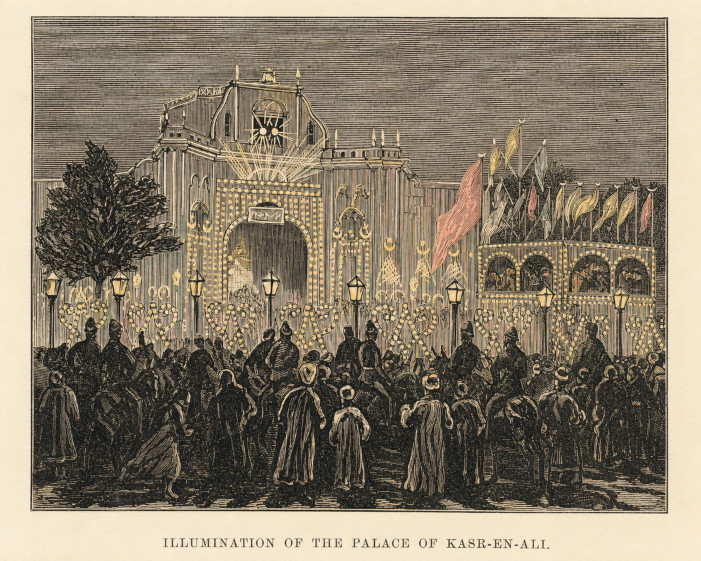
The Khedive's Return to Cairo (from Alex).Illustrated London News (London, England), Saturday, October 14, 1882
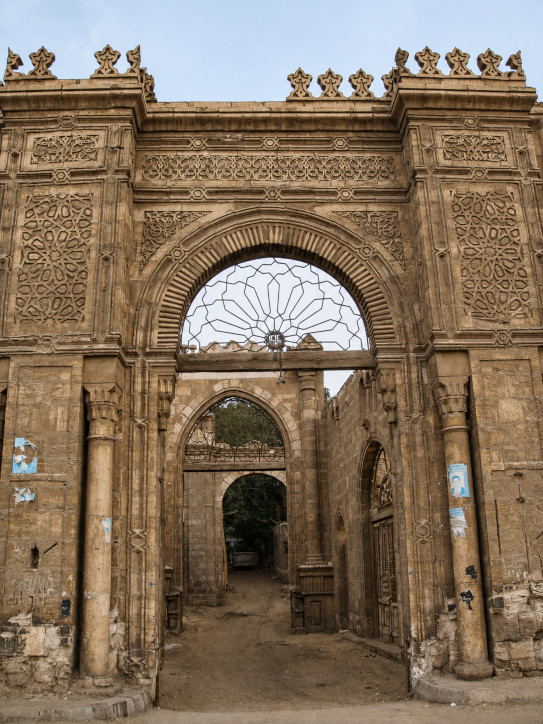
Surviving gate from El Kasr El A’ali, reused by Aly Al Wakkad in his family burial plot.
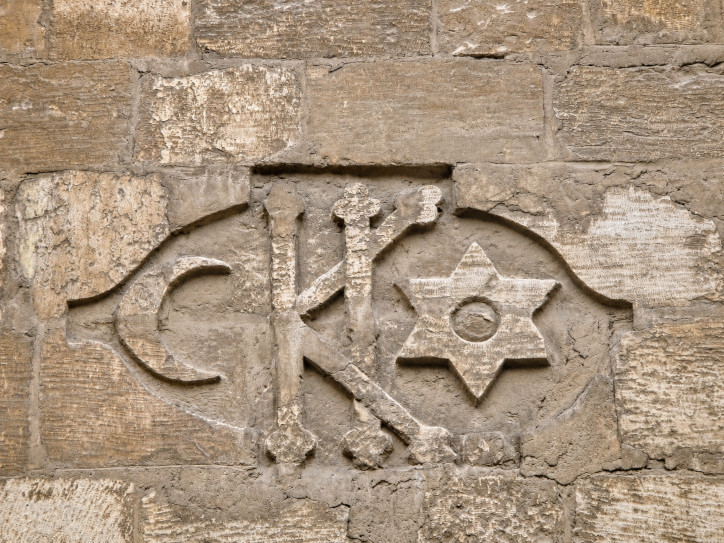
Fragments of the palace walls were carefully reused, preserving Khedive Ismail's initials.
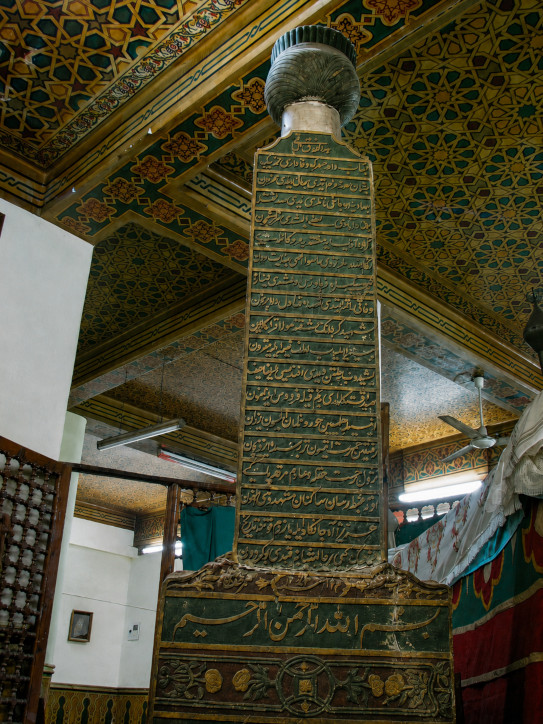
Laz-Ogly's tomb, hiding in the corner of what is now the side entrance of a modern Garden City building.

Amr S. Talaat
Amr S. Talaat, DBA, is a historian specialized in Egypt’s modern history. He has conducted extensive research on many significant events and personalities of that era. In addition to his many articles, he has published Saadeyoun ‘am Adleyoun (Sherouk Press, 2010), a book on the relationship between two prominent politicians of the early twentieth century. Sherouk Press, 2010.